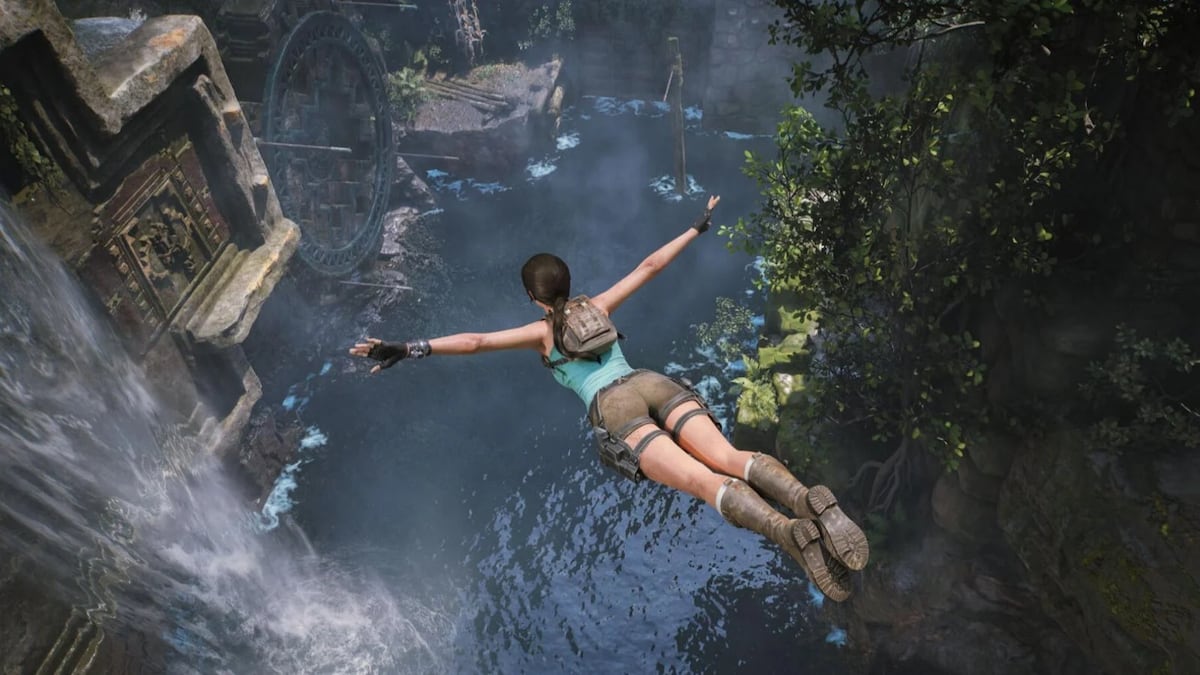
But no one gets to 30 without a few skeletons in the closet – or in Lara’s case, butlers in the freezer. So here’s a look at the darker parts of her past.
Lara’s image has been used to hawk a multitude of products over the years, from cereal and soft drinks to reasonably priced Spanish hatchbacks. Low points include the 1999 promo for a German women’s magazine in which Lara tells us what she really, really wants isn’t the Dagger of Xian or the MacGuffin of Atlantis, but a big meringuey wedding dress.
See also the weird Dreamcast advert where Lara talks about the console as if it’s a jar of anti-ageing moisturiser. This led an entire generation of women to try reducing the appearance of fine lines by rubbing Sega hardware on their faces. Because she’s worth it? Let’s hope the money was.
Back in 1996, no one predicted how successful this quiet game about a posh archaeologist made by a small team in Derby would be. But once publisher Eidos realised it was in possession of a goose that laid golden eggs, it launched an intensive battery farming operation. Core Design was forced to churn out a new Tomb Raider title every year.
Four games in, the developers had had enough. In 1999 they decided to bury Lara under a collapsing pyramid at the end of The Last Revelation. News of her demise was tucked away towards the end of the design document, the Core team having taken a punt that their publisher overlords wouldn’t bother reading that far.
They were correct. The Eidos execs were furious when they learned of Lara’s fate, but it was too late to change the game’s ending. Instead they put pressure on Core to find a narrative workaround so they could squeeze out one last PS1 adventure. The result was Tomb Raider: Chronicles, which begins with a memorial service for Lara and continues in a series of flashbacks. It is rubbish.
Lara’s first PS2 outing, The Angel of Darkness, was released in 2003. It was aiming for mature and edgy, but landed slap bang in the middle of dull and depressing.
The game missed the point of what players loved about Tomb Raider – the thrill of exploring exotic locations and abandoned temples. No one asked to wander around a gloomy version of Paris that could pass for Croydon, talking to sex workers and pawn shop owners while dressed in double denim.
It didn’t help that the game was full of bugs and had awful controls. A terrible new strength mechanic forced the player to build up Lara’s muscle before she could perform previously simple tasks, like moving a crate.
To top it all off, a secondary protagonist was introduced: tiresome edgelord Kurtis Trent, whose toxic masculinity ruined the party for everyone. Which brings us to…
Another key appeal of the original Tomb Raiders was the feeling of being a solo adventurer exploring a strange world, never knowing when the eerie silence would be shattered by the snarl of a hungry wolf. No one ever wished Lara was accompanied by a bloke in a padded gilet saying: “Hey, I wonder if that rusty key we found will fit in this rusty lock?”
But when Crystal Dynamics took over from Core in the 00s, they decided Lara needed some annoying sidekicks. The worst offender is Jonah, who makes his debut in the 2013 reboot. Not only is he feckless and mansplainy, he actively creates work for Lara by being an absolute liability. Over the course of their adventures he gets trapped, tortured, stabbed, kidnapped, knocked unconscious, shipwrecked, buried in an avalanche, caught in a tsunami, falsely declared dead, and almost killed in a plane crash. Ironically, the only calamity that doesn’t befall Jonah is being swallowed by a whale. A shame.
None of the Tomb Raider films are stellar – although many middle-aged women have a soft spot for the first Angelina Jolie outing, in which our hero dispatches an army of goons without having to leave the house, or even get out of her pyjamas.
The follow-up, The Cradle of Life, is absolute twaddle.