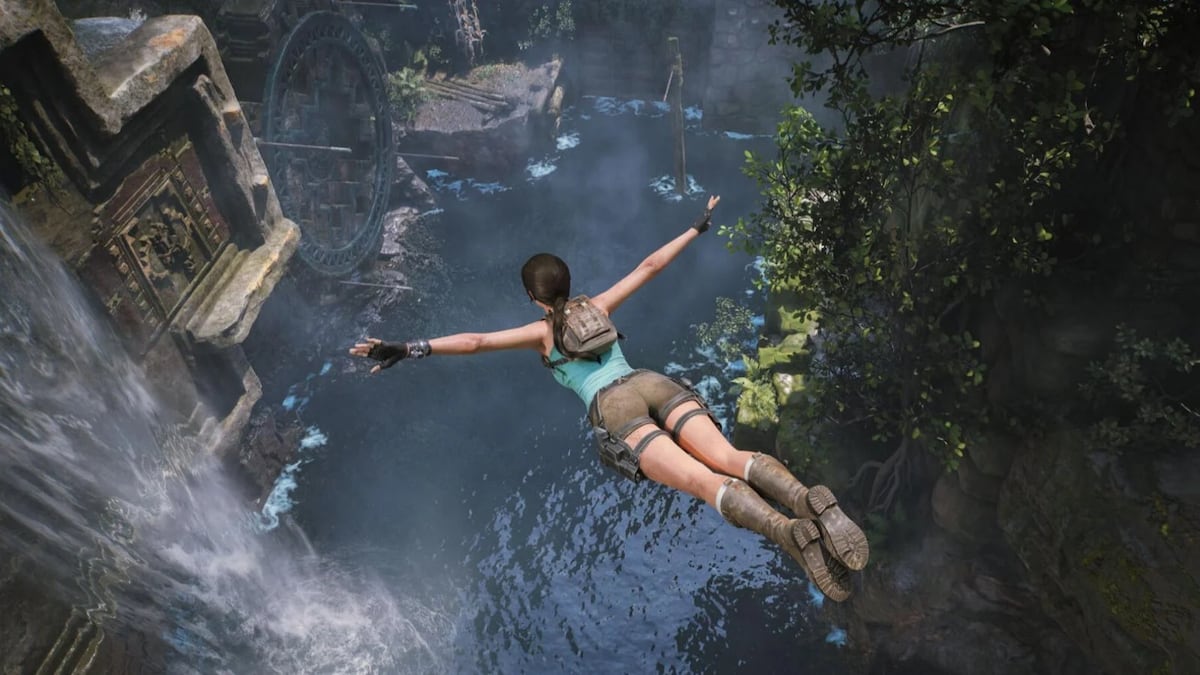
A queue snaked down Derby high street. Some of the men and women – but, notably, almost no children – waiting in line wore combat shorts and teal vests; others had come in wetsuits, while several were dressed in the coat and tails of 1930s butlers. They had all come for Tomb Raider Day, a celebration of 30 years of the video game series that debuted in 1996, and introduced Lara Croft, one of gaming’s first female characters to become a global icon.
Croft is an aristocratic archaeologist with an expensive education, serviced family manor and, in those early games, a bust as conspicuously polygonal as the tombs she explored. Before Angelina Jolie played her on screen, she appeared on the cover of the Face, bottles of Lucozade and Marks & Spencer ties – places in our culture that Mario or Sonic could never occupy. Croft was created here in Derby, by a small team at Core Design’s headquarters in a former rectory.
The building – all but the facade since demolished and made into flats – was on Luke Earle’s route to primary school. Whenever he and his mother passed it, she would tell him: “That’s where Lara Croft lives.” Earle knew Croft from watching his dad play: guiding her through intricate puzzles in improbably well-maintained underground vaults, fleeing dinosaurs or racing motorboats through Venetian canals. At five, he couldn’t make sense of his mother’s claim. Only later did he understand the connection.
In 2021, and by then working in video games himself, Earle organised the first Tomb Raider Day at Quad, the city’s arts centre, where he sits on the board of trustees. The venue had hosted popular Doctor Who events, and Earle thought the heroine might draw a similar crowd. He released 100 tickets. They sold out. He released another 100. They went too.
The response was sufficient to bring the event back the following year. It has since become an annual gathering, drawing fans from around the world. “For a lot of people, coming here is a pilgrimage,” said Earle, 34, who is intense but friendly. “That’s a strange thing to experience as someone from Derby, because I’m here all the time. Then people come all the way from Brazil, and you think: ‘Wow.’”
This year, the celebration spilled across the entire city. Alongside panels with voice actors and former developers, a 9ft Croft statue arrived at the Museum of Making, where it will stay temporarily before moving to its permanent home in Derby Market Hall. The hall also hosted family craft workshops and Tomb Raver, a themed DJ night. Earle welcomed the attention. “Our long-term aim is to make Lara Croft a kind of Robin Hood of Derby: something that draws people to the city.”
Alix Wilton Regan, a stage and screen actor and familiar voice in video games, will voice Croft in the new titles. She brought a certain celebrity frisson to Tomb Raider Day’s opening ceremony, calling Croft “maybe the most famous British female character after Peppa Pig”. During her audition, using lines from the Jolie films, she threw herself across her living room and bruised her hip on a door handle.
“Through the event, I’ve met so many people who were going through a difficult time and found that the game gave them something to focus on, helping them get through it,” said Earle. “Lara is such a confident character; people can project themselves on to her.”
That confidence has always coexisted with a more contentious image. In the early games, Croft was often criticised as oversexualised. “There were a lot of complaints,” said Andy Sandham, who worked on the third, fourth and fifth Tomb Raider titles and is at the event to talk about their making. “Some of those complaints were justified. But we always made sure that she was the strongest person in the room.”
Among the audience here, Croft’s sex appeal has become something contemporary fans play with. Dozens have come dressed as her, in outfits from across the series. Some have recreated her familiar poses in drag.