In the early 1970s, one of the finest works of ancient Greek pottery ended up at the Metropolitan Museum of Art in New York, having previously passed through the hands of tomb raiders and antiquities traffickers.
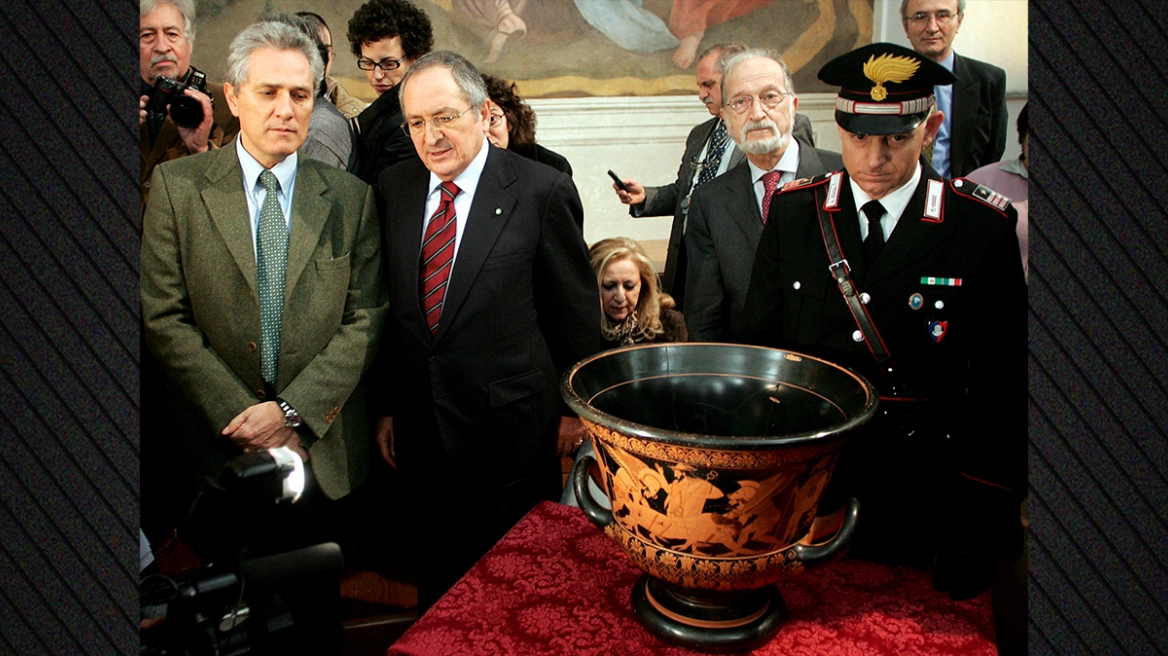
It was September 1972 when the Met paid $1.2 million (equivalent to around $9.6 million today) to acquire an ancient Greek vase created around 515 BC and bearing the signature of the celebrated vase painter Euphronios.
The significance of the acquisition was such that the museum’s director at the time declared that “from this moment on, the histories of art will have to be rewritten”, describing the krater as one of the two or three most important works the Met had ever acquired.
Yet serious allegations about its provenance soon began to emerge. The ancient Greek vase was said to have been discovered during an illegal excavation in Italy and smuggled into the United States. The case became so high-profile that the exhibit acquired the nickname “hot pot”.
As reported in a recent BBC feature on the notorious case, in 1975 the agency’s journalist John Percival followed the trail of the vase to a necropolis outside Cerveteri, Italy.
There, according to the information he had gathered, a professional tomb raider, one of the so-called “tombaroli”, had located and recovered the work from an underground tomb.
The astronomical price paid by the Met did not go unnoticed. On the contrary, it acted as an incentive for a new wave of illegal excavations in the area. “Italian tomb raiders are hunting for million-dollar vases and Italian police officers are hunting the tomb raiders,” Percival said characteristically.
On the BBC programme “Treasure Trail”, he described an entire network of illegal activity: people digging at night for ancient treasures, middlemen smuggling them across borders and, at the other end of the chain, collectors and major museums willing to acquire them, without asking too many… questions.
The Italian authorities had set up a special police unit to tackle antiquities trafficking in the Cerveteri area. Officers were even trained in ancient art by experts from Rome’s Villa Giulia Museum.
The scale of the illegal excavations, however, made control extremely difficult. Percival described an area filled with hundreds of ancient tombs, many of which could be opened relatively easily. Illegal excavations appeared in the fields as enormous holes. In one tomb that had been opened that very morning of the BBC’s visit, the antiquities traffickers had already taken whatever they considered valuable, leaving behind fragments that, in their judgement, were not worth the effort of carrying away.
At a nearby museum, vases recovered from illegal excavations had been collected, along with the tomb raiders’ tools: long metal rods with which they detected cavities underground, searching for buried tombs.
The problem, of course, was not confined to Italy. The BBC investigation reported as early as 1975 on a highly lucrative international trade in stolen antiquities stretching from South America to Europe and the US.
American explorer Howard Jennings described at the time how antiquities traffickers used electronic equipment to locate metal objects, favouring gold because it could be transported and smuggled out more easily than bulky vases.
The most striking element, according to him, was the ease with which stolen objects found buyers. Museums, auction houses, dealers and private collectors were primarily interested in one thing: whether the object was authentic. Once its authenticity had been confirmed, he said, often “no further questions were asked”.
The cost of antiquities trafficking was not merely financial. Nushin Askari, an expert at the Istanbul Museum, explained to the BBC that the destruction began from the moment of the illegal excavation. Ancient objects could even be deliberately broken up so that they could be transported more easily and smuggled across borders.