With Women Of Action, Caroline Siede digs into the history of women-driven action movies to explore what these stories say about gender and how depictions of female action heroes have evolved over time.
While the history of female-led action movies is paved with obvious cultural game-changers, I’d argue Lara Croft: Tomb Raider is just as impactful—even if what it inspired was a wave of so-so early aughts movies like Resident Evil, Underworld, Æon Flux, and Ultraviolet. Still, along with Charlie’s Angels the year before, it brought women-led action films out of the more serious mode they had fallen into in the 1990s and back towards the stylish, campy tone of the 1970s. Tomb Raider remembered that women raiding tombs and kicking ass could be fun. It’s a sensibility the genre has never entirely lost since.
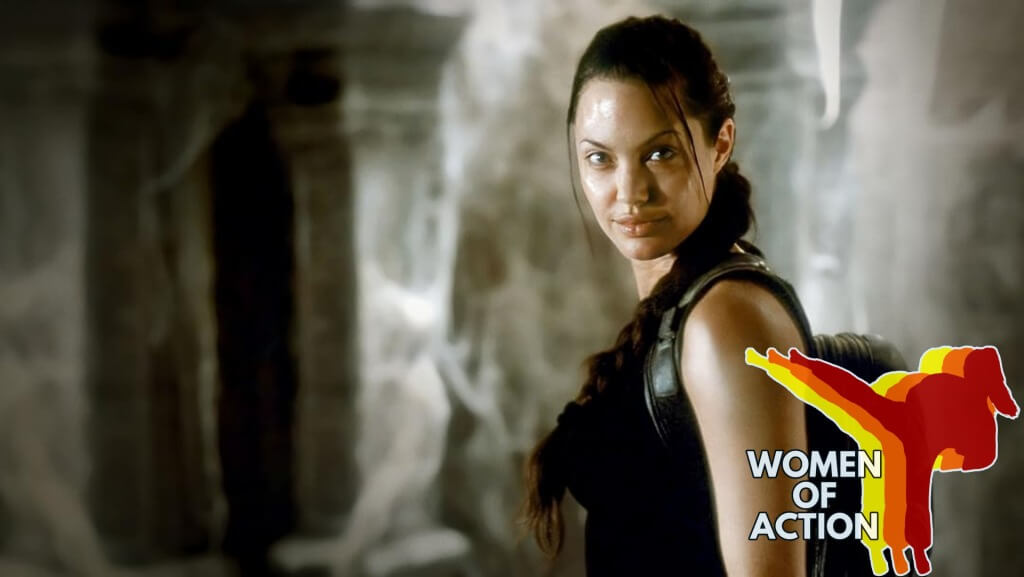
It also brought questions of sexualization back into the conversation in a major way after the earlier wave of 1970s “jiggle TV” had died down. Released in 1996, the Tomb Raider video game became a cultural sensation thanks to a buxom female heroine designed as a sex symbol for boys and an icon for girls. That colored how basically everyone received the film adaptation too. It wasn’t a question of if critics would talk about Jolie’s boobs, but how lewd they would get.
“Among the special effects, the stone monkeys rock, but you might be more distracted by the fact that Jolie’s breasts seem to balloon and deflate from scene to scene,” Rolling Stone observed. Meanwhile, the Newsday review opens, “All lips and legs, Angelina Jolie struts through Lara Croft: Tomb Raider the way Samuel L. Jackson swaggered through Shaft—as if nothing in the movie mattered but her own sex appeal.” It then goes on to note that “lusty cheers” erupted “each time a piece of her anatomy crossed the screen.”
It’ll drive you crazy to read interviews and profiles from this era, where Jolie is casually asked about her bust as if that’s a normal follow-up to a question about her stunt training regime. “C’mon, I’m not so flat chested to begin with,” she replies before sharing her own bra size in relation to Lara’s, as if she needs to provide concrete proof. “We still made it Lara Croft, but we didn’t go to any extremes… We did want to put in something for those hardcore game fans. Lara has those big breasts in the game. We didn’t want to make them as big as in the game, but at the same time we didn’t want to take away from her the things that are, you know, her trademarks.”
Perhaps it’s just because this movie broke the seal for a wave of even more sexed-up action flicks like Catwoman and Sucker Punch, but from a modern perspective, Tomb Raider actually doesn’t even feel egregiously filtered through the male gaze. Revisiting all the boob-focused press is a bit like looking back on the Pippa Middleton “buoyant bum” discourse from the 2011 royal wedding and wondering what the hell everyone was thinking at the time. This is what felt noteworthy in 2001?
Still, cracking how to adapt the video game heroine was no small task. The script went through a dozen different iterations and a truly absurd number of screenwriters throughout the late 1990s until Con Air director Simon West finally boarded the project and pulled the best elements of those previous drafts into one vaguely legible story that didn’t overthink the gender of its lead. As Jolie explained in 2002, “I read the first draft of Tomb Raider, and Lara Croft was always kicking somebody in the nuts, and they were always making a point that she was a girl, and there was always something about how stupid men are, and I hated that. I, along with the director, removed it all. That wasn’t the point.”
Though the action genre can be a powerful medium for processing everything from trauma and abuse to female solidarity and motherhood, what’s fun about Tomb Raider is that there’s absolutely no layer of metaphor at play.