Video game character Lara Croft has spent three decades raiding tombs across the globe in her quest to find valuable lost artefacts.
Little does she know that a real Tomb Raider treasure trove can be found in a spare bedroom in Milton Keynes.
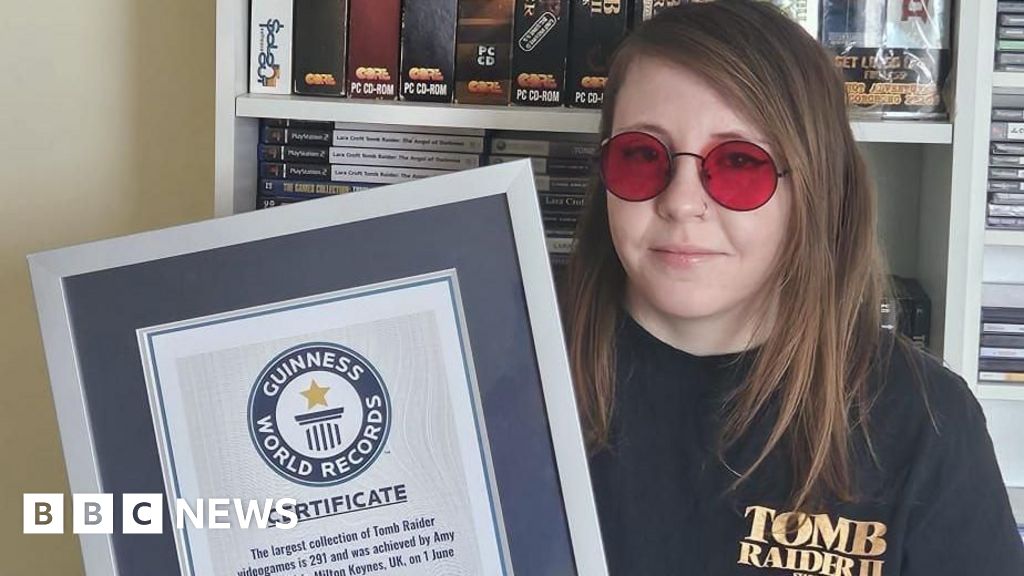
There, Amy Dyson, 33, keeps 341 individually boxed games from the franchise, guarded by a life-sized statue of Lara herself hiding in the corner of the room.
The collection ranges from a boxed copy of the first game, released in 1996, to imported copies of the most recent releases from Japan alongside posters, toothbrushes, skateboards and more.
This carefully curated hoard earned Amy a Guinness World Record last summer for the largest collection of Tomb Raider video games, back when she had a mere 291 games in her collection.
While her love of the games drove the collection, Tomb Raider has also played a crucial role in her life.
She explains: “Prior to lockdown, I developed a really peculiar tremor that just wouldn’t stop, and doctors couldn’t diagnose me; they didn’t know what was wrong with me.
“Eventually, after the first lockdown, I got diagnosed with a condition called Functional Neurological Disorder (FND), which basically means my brain doesn’t send or receive signals properly.”
The gamer says her symptoms can be unpredictable, ranging from brain fog and ticks to tremors and periods of temporary paralysis.
Having played the games since childhood, the familiar puzzles work as a distraction to calm her brain until physical symptoms subside.
“When I get brain fog or if I’m basically paralysed and I can’t go into work… I’ll just play Tomb Raider,” she says.
“I turned to Tomb Raider because I know what I’m doing, and then everything kind of just blows over, and it stops, and I calm down, and everything’s better.”
Amy grew up in the Shropshire village of Clun, which she describes as “literally the middle of nowhere”.
As one of three girls in her school year, Amy found gaming was a male-dominated space, and she was often relegated to watching her brother play.
She wanted an action-focused game for herself, and she found it when her dad brought home Tomb Raider II in the late 1990s.
Created by Derby-based developer Core Design Limited, the series follows dual-pistol-wielding adventurer Lara Croft as she searches for ancient artefacts.
“My dad installed it and killed Lara within the first five minutes,” Amy recalls, noting he drowned the character because he couldn’t find the swimming button.
She took over the controls and quickly connected with the character, who she thought was “a right badass”.
She recalls: “The best thing you can do [in Clun] is just go for a walk, but for me, after playing the game, I just felt really, really confident and really powerful.
“I was going for a walk but- oh! There’s a wall! Let’s jump on the wall like Lara.”
Lara remained a constant in Amy’s life as she grew up, eventually becoming the subject of her university dissertation.
On her 21st birthday, she was gifted some of the Tomb Raider merchandise she had wanted growing up, which her family could not afford when she was younger.
This sparked the urge to track down other items she wanted as a kid, and she started to put together her collection.
“I have adult money now,” she jokes, “so I can do whatever I want”.
Early on, she ended up with a 6ft statue of Lara Croft, which she put on display in her student house.
“My landlord did a house tour at one time, and they didn’t know about it,” she recalls.
“They were absolutely stunned when they came through the door, and she was just pointing a gun in their face.”
When faced with the unpredictability of an FND diagnosis, Amy realised she had to “live the moment” as the condition was “so spontaneous, anything can happen”.
She decided to channel her love of Tomb Raider into a challenge.
“So, I thought to myself…

.png?width=1200&height=630&fit=crop&enable=upscale&auto=webp)